Tragedy of July 7, 1998 In the eyes of many Nigerians and some international observers, M.K.O. Abiola was effectively Nigeria’s president-elect – their president in waiting, who vowed not to renounce the mandate, and the day he died on July 7, 1998, cannot be easily forgotten. I was a student at the University of Lagos, and it is worth mentioning that at the time I was just another potential “yuppie” on campus. At that point in history, I had not undergone the process of sociopolitical radicalisation that transformed me into Owoism – another chapter in my eventful life. The June 12 struggle played a pivotal role in my transformation, and the following events were a part of that process. At that particular moment, I had just entered the main library of the University of Lagos. I was greeted by a family friend who worked as a librarian, and since he knew my family history, he informed me the sad news just broke on TV. The murmuring of “Abiola is dead” increased and reverberated thro...
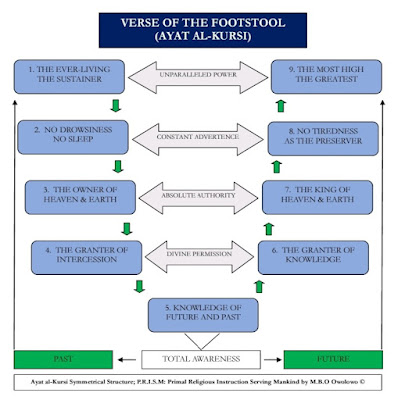
Symmetrical Structure of Ayat al-Kursi (Verse of The Footstool) The most powerful Ayah in the Quran is Ayat al-Kursi aka Ayatul Kursi and is commonly translated as Verse of The Throne. Though allegorical, it is more linguistically accurate to translate as Verse of The Footstool; where Kursi represents 'Footstool' instead of 'Throne' – which literally means Arsh. Ayatul Kursi is embedded within Surah Baqarah; which is the longest Surah of the entire Quran – Chapter 2 (The Cow). Baqarah has 286 verses, and the verse of the throne is verse 255. Allah! There is no god ˹worthy of worship˺ except Him, the Ever-Living, All-Sustaining. Neither drowsiness nor sleep overtakes Him. To Him belongs whatever is in the heavens and whatever is on the earth. Who could possibly intercede with Him without His permission? He ˹fully˺ knows what is ahead of them and what is behind them, but no one can grasp any of His knowledge—except what He wills ˹to reveal˺. His Seat encompasses the hea...
All Deities Mythical and Autochthonal Deity comes from the Latin word for God – Deus, then in French it is Deité, and in English it is "Deity". Deification is to deify – treat something or someone god-like. Deify can be appreciated as a cognate of deity. From an etymological perspective, Augustine of Hippo derived the term deity from “divine nature” – which is translated as Deitas in Latin. Deity is often associated with the supernatural or the divine and the identifiers can be pluralized or genderized as gods or goddesses – which are common terms in polytheism. From history to date, all deities, regardless of their geographical situation, emanation or manifestation, are either mythological or autochthonous. There are many examples of autochthonous deities named after aspects of nature, natural phenomenon, cosmology and astronomy. For instance, sun and moon deities are revered across various cultural traditions and were at times given indigenous names or titles associ...


Comments
Post a Comment